Back in April 2025, I wrote at length about the Saturn and Neptune Conjunction. You can read the full article here.
For those who still do not have access to my paid members-only posts, here is a small excerpt.
The previous Conjunction occurred at 11°55’ Capricorn and the Second House on March 3, 1989.
Several major events marked 1989: the Tiananmen Square protests in China, the collapse of communist regimes across Eastern Europe, the Fall of the Berlin Wall, which symbolically signalled the end of the Cold War, and the birth of the World Wide Web.
1989 was a turning point in political history, marked by the “Revolutions of 1989,” which ended communism in the Eastern Bloc of Europe. This series began in Poland and Hungary, culminating with the opening of the Berlin Wall in November, the Velvet Revolution in Czechoslovakia, and the overthrow of the communist dictatorship in Romania in December. The movement concluded in December 1991 with the dissolution of the Soviet Union. While revolutions against communist governments in Eastern Europe mainly succeeded, the year also witnessed the suppression of the 1989 Tiananmen Square protests in Beijing by the Chinese government.
The fall of the Berlin Wall on 9 November 1989, during the Peaceful Revolution, marked the beginning of the end for the Berlin Wall and the symbolic Iron Curtain, as East Berlin’s transit restrictions were overwhelmed and discarded.
The dissolution of the Soviet Union, marking the end of a superpower that had shaped global politics for much of the 20th century, occurred on December 26, 1991. This event concluded the Cold War and reshaped the geopolitical landscape, leading to the emergence of 15 independent republics.
It was the year of the first Brazilian direct presidential election in 29 years.
The first commercial Internet service providers emerged this year, with the first written proposal for the World Wide Web and the initial Internet connections in New Zealand, Japan, and Australia.
The Saturn-Neptune Conjunction occurs roughly every 36 years, but not regularly.
The relevance of the number 36 is that it matches the number of decans of the zodiac, suggesting a complete cycle.
36 is both the square of six and the eighth triangular number, or the sum of the first eight non-zero positive integers, making 36 the first non-trivial square triangular number.
Jewish tradition holds that the number 36 has had special significance since the beginning of time. According to the Midrash, the light created by God on the first day of creation shone for exactly 36 hours.
The 36-year pattern reveals a combination of revolution and systematic changes (1773, 1917, 1989), scientific and technological breakthroughs (1665 – Newton, 1953 – DNA, 1989 – Web), pandemics and health crises 1665 – Plague, 1918 – Spanish Flu), and cultural and ideological rises (1737 – Enlightenment and 1773 – Liberalism).
As I stated, I expect no less than a severe political and social earthquake, which may also reshape the global economy and power geometry. And for now, things are going as expected.
The calendar year started strong, with the U.S. intervention in Venezuela, specifically Operation Absolute Resolve, which occurred on January 3, 2026, when U.S. forces captured President Nicolás Maduro and his wife. January 3 coincided with the day of the Full Moon in Cancer. The Full Moon represents a moment of culmination and clarity, often associated with the completion of cycles and the manifestation of intentions.
While on the global map of drug trafficking, Venezuela is rather insignificant, the country represents an important oil reserve. Approximately one-tenth of Venezuela’s $150 billion in foreign debt is estimated to consist of loans from China repaid with oil shipments. Thus, the U.S. taking over control of Venezuela’s oil exports and finances may lead to another proxy conflict with China.
The 56th Annual Meeting of the World Economic Forum took place in Davos, Switzerland, from January 19 to January 23, 2026.
Coincidentally, – I’m kidding! – on January 20, the Sun and Mercury entered Aquarius. Venus met Pluto. Saturn forms a sextile to Uranus. Mars is trine Uranus and in sextile to Saturn. On 21 January, the Sun met Mercury; on 22 January, Mercury reached Pluto, and the Sun followed on 23 January. On that same day, Mars moved into Aquarius.
Important developments are taking place during this time, establishing a new direction. It’s time to choose sides clearly. Power structures are becoming more visible, while covert power dynamics are still at work.
This is an opportune moment for meaningful reforms that enhance future sustainability. Initiatives and agreements that combine integrity with a pioneering spirit are gaining attention. The focus is shifting noticeably toward collective efforts and networking. Shared objectives, socially relevant projects, and technological innovations are emerging as key priorities.
What happened at Davos?
Probably the most significant event was the Board of Peace’s signing ceremony and inauguration meeting on January 22.
Around 60 countries received invitations from U.S. President Donald Trump to join the Board of Peace, yet did not gain support from several Western countries. 20 countries, mostly from the Middle East, Asia and South America, including Argentina, Azerbaijan, Indonesia, Mongolia, Pakistan, Paraguay, Qatar, Saudi Arabia, Turkey, United Arab Emirates, and Uzbekistan, and only two European Union member states, Hungary and Bulgaria, signed the Board. Albania, Belarus, Egypt, Israel, Kuwait, and Vietnam announced their intention to join, while France, Germany, Ireland, Italy, Norway, Slovenia, Spain, Sweden, and the United Kingdom have declined Donald Trump’s invitation.
The Board of Peace is an international organisation established by U.S. President Donald Trump to promote peacekeeping and stability, particularly in conflict-affected areas like Gaza.
It aims to operate alongside the United Nations. However, in the long term, it is more likely to provide an alternative for addressing critical international conflicts.
The refusal by Western European countries is a clear signal of the worsening relations between the U.S. and Europe. If, in the last year, the bone of contention was the conflict in Ukraine, in recent weeks, tensions have increased over Greenland. Several European countries, France, Germany, Sweden, Norway, Finland, the Netherlands, and the U.K., opted to deploy small military contingents to Greenland. It is an unprecedented situation in which NATO allies are operating against the United States, the alliance’s dominant power. While purely symbolic, it shows the current state of affairs between the U.S. and its European allies.
The newly developed situation led us to another hot potato. The North Atlantic Treaty Organisation (NATO), founded in 1949 in the aftermath of World War II, served as a system of collective security and defence against an attack by any outside party, primarily targeting the Soviet Union. However, the end of the Cold War, with the dissolution of the Soviet Union and the disbandment of the Warsaw Pact in 1991, created a new geopolitical and military reality in which NATO’s purpose and function should have been redefined.
NATO concluded a major military intervention in Bosnia and Herzegovina between 1992 and 1995, followed by another intervention in Yugoslavia in 1999. In 2001, after the September 11 attacks, NATO deployed troops in Afghanistan and had another intervention in Libya in 2011.
The war in Ukraine is another critical point of contention in which the U.S. and Europe currently have radically different opinions and approaches.
Mark Rutte, a Dutch politician and the serving 14th Secretary General of NATO, noted the obvious: “NATO is powerless without the U.S.”
Meanwhile, the United States officially completed its withdrawal from the World Health Organisation (WHO) on January 22, citing the organisation’s mishandling of the COVID-19 pandemic and failure to implement necessary reforms.
It’s becoming clear that the old international institutions have failed to prevent or manage crises, while corruption and ideological biases have crippled their ability to provide viable solutions for the modern world’s challenges. Viktor Orbán, prime minister of Hungary since 2010, recently stated that: “If we keep forcing what won’t work, nothing will change. It’s time to break the cycle.”
The world is changing, the old systems are failing, and we need new institutions to replace them. However, people with old mentalities cannot reinvent themselves and break out of the Matrix. Without genuine, profound inner transformation at the individual level and a collective will for general change, the external world cannot be reformed.
On January 26, Neptune moved into Aries and remains there until March 27, 2039. It’s a significant step towards the Conjunction with Saturn.
The last time Neptune entered Aries was on April 13, 1861, the day after the American Civil War began.
Neptune, embodied by the Tarot card Sacrifice, known as the Hanged Man in traditional decks, dissolves boundaries, ideals, and certainty and deals with the ego. Aries, represented by the Emperor, initiates, acts, asserts, leads, and reacts. Their combination may manifest as actions with concealed intentions. An apparent course of action may have a hidden purpose and yield an outcome different from what is suspected.
What to observe in the following period?
While the Saturn and Neptune Conjunction will occur on February 20, the two planets will remain in relative proximity until March 9, 2027, when they will drift apart over ten degrees.
You should also keep in mind that change takes time, and each paradigm shift requires a transition. Some events are catalysts for change, others result from one or more ongoing processes. Just like in 1989, some processes have already started, while events that will reshape the world will continue throughout the next months.
One critical hotspot on the geopolitical map is Ukraine. The outcome of the conflict in Ukraine will have a significant impact on Europe’s future. While it’s already negatively affected Europe’s economy, the situation can further aggravate. Just one question: how many more billions can Brussels print to throw into the black hole called Ukraine, and at what cost?
In a developing multipolar new world architecture, Europe becomes irrelevant and left behind. It’s not everything lost yet, but Europe is on the brink of economic, political, social, and cultural collapse. And Europe is only one fortress; the entire Western civilisation is under attack from within and without.
The other two critical spots are Iran and Taiwan.
Iran is a crossroads of American, Chinese, and Russian interests, while Taiwan can be decisive in the future development of the America-China relationship and power balance.
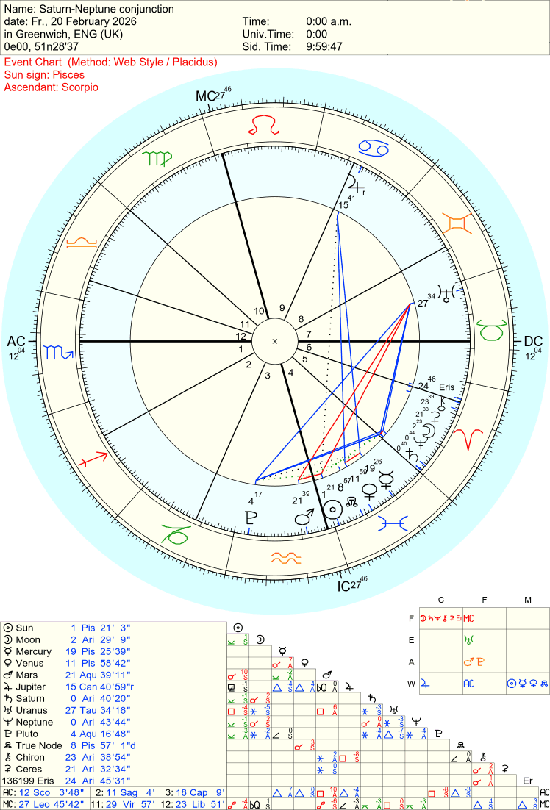
On February 20, the two planets will be in Aries and the 5th House, with Saturn at 0°40’20” and Neptune at 0°43’44”.
The Conjunction marks the beginning of a new 36-year cycle. While Saturn, embodied by the Devil card, is considered a force that sets boundaries, Neptune, represented by Sacrifice (the Hanged Man in standard Tarot decks), dissolves them. It is also a representation of the clashing interests of the established system, represented by the Devil, and the individual, expressed by Sacrifice. The pressure from the inner world may eventually influence and alter the shape of the external world. However, the new beginning in Aries, a Fire sign, can trigger violence.
The 5th House, attributed to the Strength card, favours creativity and self-expression. It’s an opportunity to find your voice and express your thoughts and feelings unrestrained.
Interesting times lie ahead, yet the outcome depends primarily on our choices and actions.
Please keep in mind: the unseen matters more than the visible.
#astrology #tarot #unifiedesoterictarot #attilakarpathy