There is an undocumented claim that each new member of the Hermetic Order of the Golden Dawn had to draw and paint their own Tarot deck as part of their initiation and learning process.
While this is a brilliant idea, the total lack of evidence that members of the Order created such decks makes the theory questionable. Not a single card from any of these alleged decks ever surfaced. The original Order had around 400 members, including many celebrities such as Florence Farr, Maud Gonne, William Butler Yeats, Arthur Machen, Evelyn Underhill, Sax Rohmer, and others.
Probably, you don’t have to build your own engine to become a brilliant race driver, but the combination of theory and practice is absolutely critical in any esoteric matter.
Just like drawing and painting, your self-designed Tarot deck is a learning curve and an esoteric spiritual experience; painting Easter eggs can be similarly rewarding. It’s about focus, immersion in the spirit of the celebration, and beyond the artistic dimension, it’s charged with spirituality.
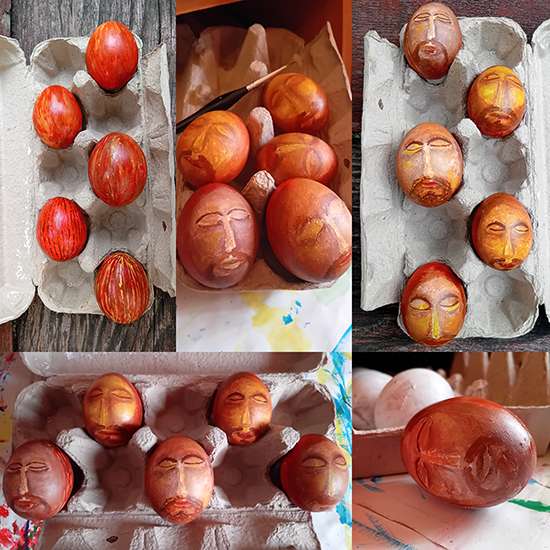
I’m not a religious person, but a spiritual one. It’s been quite a long time since I painted Easter eggs. This year’s inspiration was the famous Shroud of Turin, a stylised portrait of Christ on the eggs. I guess art is more about inspiration – what an interesting word! – rather than raw talent. Probably I’m not very talented either, but occasionally inspired.
“Inspiration” derives from the Latin verb “inspirare”, composed of “in”, meaning “into”, and “spirare,” meaning “to breathe.” Thus, inspirare literally means “to breathe into.” From this verb comes the noun inspiratio, meaning “a breathing into” or “infusion.”
The root spirare is part of a wider Indo-European family associated with breath and life force, linking “inspiration” conceptually to vitality, spirit, and animation.
So, inspiration means something external and initially considered divine that enters and animates the inner self.
The Shroud of Turin is one of the most enigmatic and debated relics in Christian tradition. Believed by many to be the burial cloth of Jesus Christ, the Shroud is a length of linen bearing the faint, full-length image of a man who appears to have suffered wounds consistent with crucifixion. Housed today in the Cathedral of Saint John the Baptist, it has attracted pilgrims, scientists, and sceptics alike for centuries.
The documented history of the Shroud begins in the fourteenth century in Lirey. However, proponents argue that it may be identical to earlier relics, such as the mysterious Image of Edessa. Over time, it came into the possession of the House of Savoy and was eventually transferred to Turin, where it remains. Its image is unique: not painted or dyed in any conventional sense, but appearing as a negative imprint that reveals remarkable anatomical detail when photographed.
Scientific examination has both deepened and complicated the mystery. In 1988, radiocarbon dating tests conducted by laboratories in Oxford, Zurich, and Tucson suggested that the cloth dates from the medieval period, roughly between 1260 and 1390. This finding led many scholars to conclude that the Shroud is a pious forgery. However, critics of the testing have pointed to possible contamination, repairs, or sampling errors, keeping the debate open. Further studies using modern imaging and forensic techniques have highlighted the complexity of image formation, which remains unexplained.
The tradition of painting eggs for Easter is one of the most enduring and meaningful customs associated with the celebration of spring and renewal. Originating from both pre-Christian and Christian practices, the decorated egg has become a universal symbol of life, rebirth, and spiritual transformation.
Long before the rise of Christianity, eggs were revered in many ancient cultures as potent symbols of fertility and regeneration. In Persian, Egyptian, and Greek traditions, eggs were often exchanged during spring festivals to mark the end of winter and the awakening of the natural world. Their smooth, enclosed form suggested the mystery of life emerging from apparent stillness, making them ideal representations of cyclical renewal.
With the spread of Christianity, this symbolic framework was reinterpreted within a theological context. The egg came to signify the resurrection of Jesus Christ, with its hard shell representing the sealed tomb and the life within symbolising Christ’s emergence from death. Dyeing eggs red symbolises the blood shed by Jesus at his crucifixion, suggesting that his blood may have splashed over baskets with eggs brought by the people from the gathering.
In many Christian communities, eggs were also associated with the end of Lent, a period of fasting during which eggs were traditionally forbidden. Their reintroduction at Easter made them both a celebratory food and a sacred symbol.
The practice of decorating eggs developed differently across regions, giving rise to a wide array of artistic traditions. In Eastern Europe, particularly in countries such as Ukraine and Romania, egg painting became a highly sophisticated folk art. Ukrainian pysanky, for instance, are created using a wax-resist method, where intricate geometric and symbolic patterns are layered in multiple colours. Each motif, whether a sun, a plant, or an animal, carries specific meanings related to protection, prosperity, or spiritual harmony. Similarly, Romanian painted eggs often feature symmetrical designs and vibrant colours, reflecting both religious themes and local folklore.
Esoteric deals with the unseen.
Painting is a matter of inspiration and expression.
#easter #egg #art #esoteric #attilakarpathy